
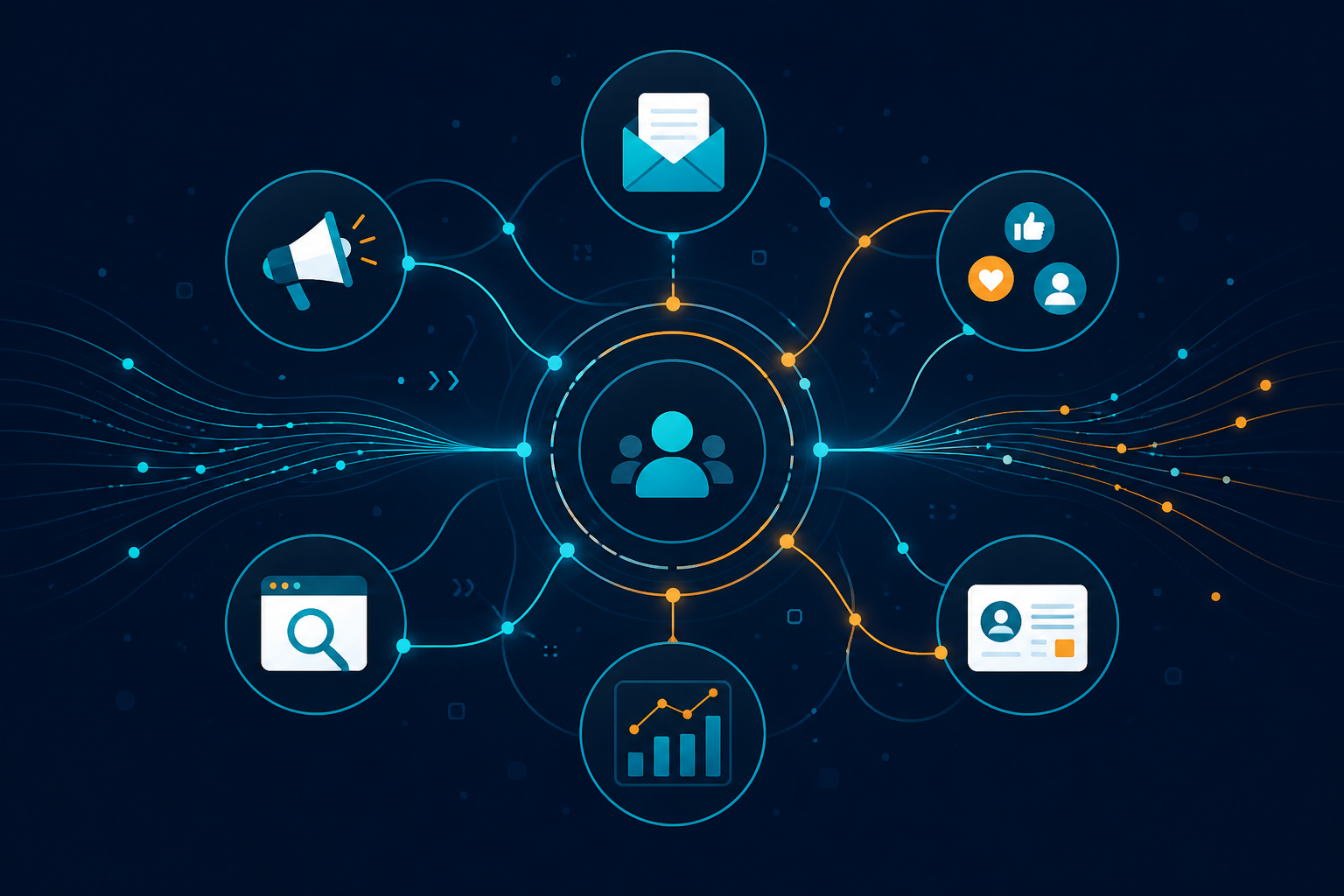
In today's hyper-connected business world, your customers don't experience your brand in isolated pockets. They interact with your content on social media, find your solutions through search engines, receive your drip campaigns, and engage with your sales team — often all within the same buying journey. Yet, many businesses still treat their digital marketing channels as separate entities, leading to fragmented experiences and missed opportunities. This is where the power of digital integration marketing comes into play.
According to Salesforce's State of Marketing report, high-performing marketing teams are 1.6x more likely to use integrated, cross-channel campaign management than underperformers. The gap between integrated and siloed marketing isn't just about efficiency — it's becoming the difference between growth and stagnation.
The Power of Unified Digital Marketing
Digital integration marketing is the strategic approach of synchronizing all your digital marketing channels, tools, and data to create a seamless, cohesive, and impactful customer experience. It's about ensuring that your website, social media, email campaigns, SEO efforts, paid advertising, and CRM all work together in harmony, telling a consistent brand story and guiding prospects effortlessly through their buyer's journey.
For modern businesses, especially in the B2B landscape, an inbound marketing approach isn't just a nice-to-have; it's a necessity. It moves beyond simply having a presence on various platforms to ensuring those platforms communicate with each other, share data, and reinforce a unified message. This holistic view allows you to understand your customers better, personalize their experience, and ultimately drive more meaningful engagement and conversions.
Beyond Silos: Why Integration Matters for B2B
The B2B buying cycle is often complex, involving multiple stakeholders, extended research phases, and significant investment. When marketing channels operate in silos, the challenges are amplified:
- Inconsistent Messaging: Different departments or agencies managing separate channels can lead to conflicting brand messages, confusing prospects.
- Duplicated Efforts: Teams might unknowingly create similar content or target the same audience segments, wasting resources.
- Fragmented Data: Without a central repository or integrated analytics, it's difficult to get a complete picture of customer behavior, making optimization a guessing game.
- Poor Lead Nurturing: Leads generated from one channel might not be seamlessly passed to nurture sequences or receive relevant follow-up, leading to high drop-off rates.
- Inefficient Resource Allocation: Without clear insights into which channels are truly contributing to revenue, budget allocation becomes less strategic.
Digital integration marketing addresses these issues head-on. By breaking down these silos, B2B companies can:
- Improve Lead Generation Quality: By understanding the full customer journey, you can optimize lead magnets and use lead scoring to prioritise the best opportunities across channels.
- Enhance Lead Nurturing: Integrated CRM and marketing automation ensure that leads receive personalized, contextually relevant content at every stage, moving them closer to conversion.
- Boost Conversion Rates: A consistent brand experience and personalized interactions build trust and reduce friction in the buying process.
- Gain Deeper Customer Insights: Centralized data provides a 360-degree view of your customers, enabling more effective segmentation and targeting.
- Maximize ROI: Optimized resource allocation and better-performing campaigns lead to a higher return on your marketing investment.
"In the B2B world, an integrated marketing strategy isn't just about efficiency; it's about empathy. It allows us to understand our customers' journeys deeply and respond with relevant, consistent value at every touchpoint."
Research from Gartner reinforces this perspective: companies with aligned, integrated marketing and sales functions see 24% faster growth and 27% higher profitability than those operating in silos. Integration isn't a technical project — it's a growth strategy.
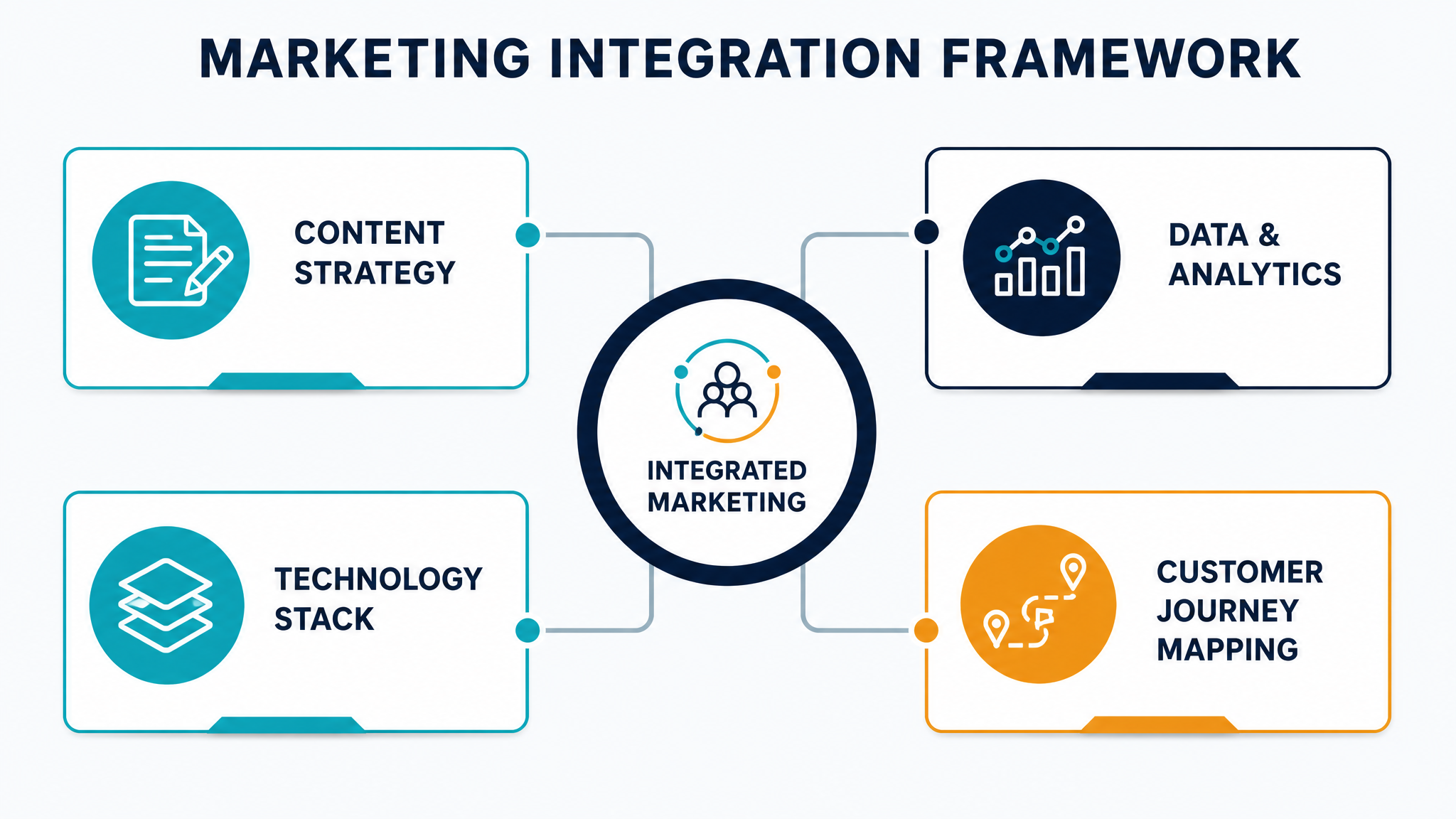
Key Pillars of an Integrated Digital Strategy
Building an effective integrated digital strategy requires focus on several core components:
1. Content Strategy
Your content is the fuel for all your digital channels. An integrated content strategy ensures that content is:
- Consistent: Aligned with your brand voice, messaging, and value proposition across all platforms.
- Repurposed: A single piece of long-form content can be broken down into social media posts, email snippets, infographics, and more.
- Contextual: Tailored to the specific channel and the stage of the buyer's journey the prospect is in.
2. Data Integration and Analytics
This is the backbone of integration. Connecting data from your CRM, marketing automation platform, website analytics, social media, and advertising platforms provides a unified view of performance. This enables:
- Holistic Reporting: Understanding how different channels contribute to overall goals.
- Personalization: Using customer data to deliver highly relevant content and offers.
- Predictive Analysis: Identifying trends and anticipating future customer needs.
HubSpot's research shows that companies using integrated data and analytics are 2.2x more likely to exceed their lead generation goals. When your data talks, your marketing performs.
3. Technology Stack Alignment
Your marketing technology (MarTech) stack should work together seamlessly. Choosing the right marketing platform is critical, but so is connecting your stack so tools share data automatically. This often involves:
- CRM: As the central hub for customer data.
- Marketing Automation Platforms (MAP): For lead nurturing, email campaigns, and automated workflows.
- Analytics Tools: Google Analytics, Adobe Analytics, or similar platforms.
- Content Management Systems (CMS): To manage and deliver website content efficiently.
- Social Media Management Tools: For scheduling, publishing, and listening.
The goal is to minimize manual data transfers and maximize automated workflows between these systems.
4. Customer Journey Mapping
Understanding your customer's journey from awareness to advocacy is paramount. This involves:
- Identifying Touchpoints: Where and how do customers interact with your brand?
- Mapping Pain Points: What challenges do they face at each stage?
- Aligning Content and Channels: Ensuring the right message is delivered on the right channel at the right time.
Measuring Success: KPIs for Integrated Campaigns
To truly understand the impact of your integrated efforts, you need to track the right Key Performance Indicators (KPIs). Beyond individual channel metrics, focus on those that reflect the collective power of your strategy:
- Customer Lifetime Value (CLTV): Integrated efforts should lead to stronger customer relationships and higher CLTV.
- Cost Per Acquisition (CPA): By optimizing across channels, you should see a reduction in the cost of acquiring new customers.
- Marketing Qualified Leads (MQLs) to Sales Qualified Leads (SQLs) Conversion Rate: A seamless nurturing process should improve this crucial handoff.
- Revenue Attribution: Understanding which channels and touchpoints contribute to closed deals, often requiring multi-touch attribution models.
- Website Engagement Metrics: Time on site, pages per session, and bounce rate across all traffic sources.
- Brand Sentiment and Awareness: Tracked through social listening and brand surveys, reflecting a consistent brand experience.
- Cross-Channel Engagement: How many channels does a typical customer engage with before converting?
Regularly reviewing these KPIs will allow you to identify what's working, where adjustments are needed, and how your integrated strategy is contributing to overall business objectives.
Your Path to Integrated Marketing Excellence
Implementing a truly integrated digital marketing strategy is a journey, not a destination. It requires commitment, collaboration across teams, and a willingness to adapt. Start by conducting a marketing automation audit to assess your current efforts, identify existing silos, and map out your customer's journey. Then, gradually work towards connecting your tools, unifying your data, and aligning your content strategy.
If you're ready to unlock the full potential of your digital marketing and drive more consistent, impactful results, consider taking a strategic look at your current setup. Our marketing diagnostic can help you identify gaps and opportunities in your existing digital strategy, providing a clear roadmap for achieving true integration and accelerating your business growth.